How a Single Mum Ends Up £17,000 in Debt Without One Reckless Purchase
One income. Two children. Seventeen thousand pounds of debt. I do the same sum at the kitchen table every month, after the children are asleep, and it never quite comes out right.
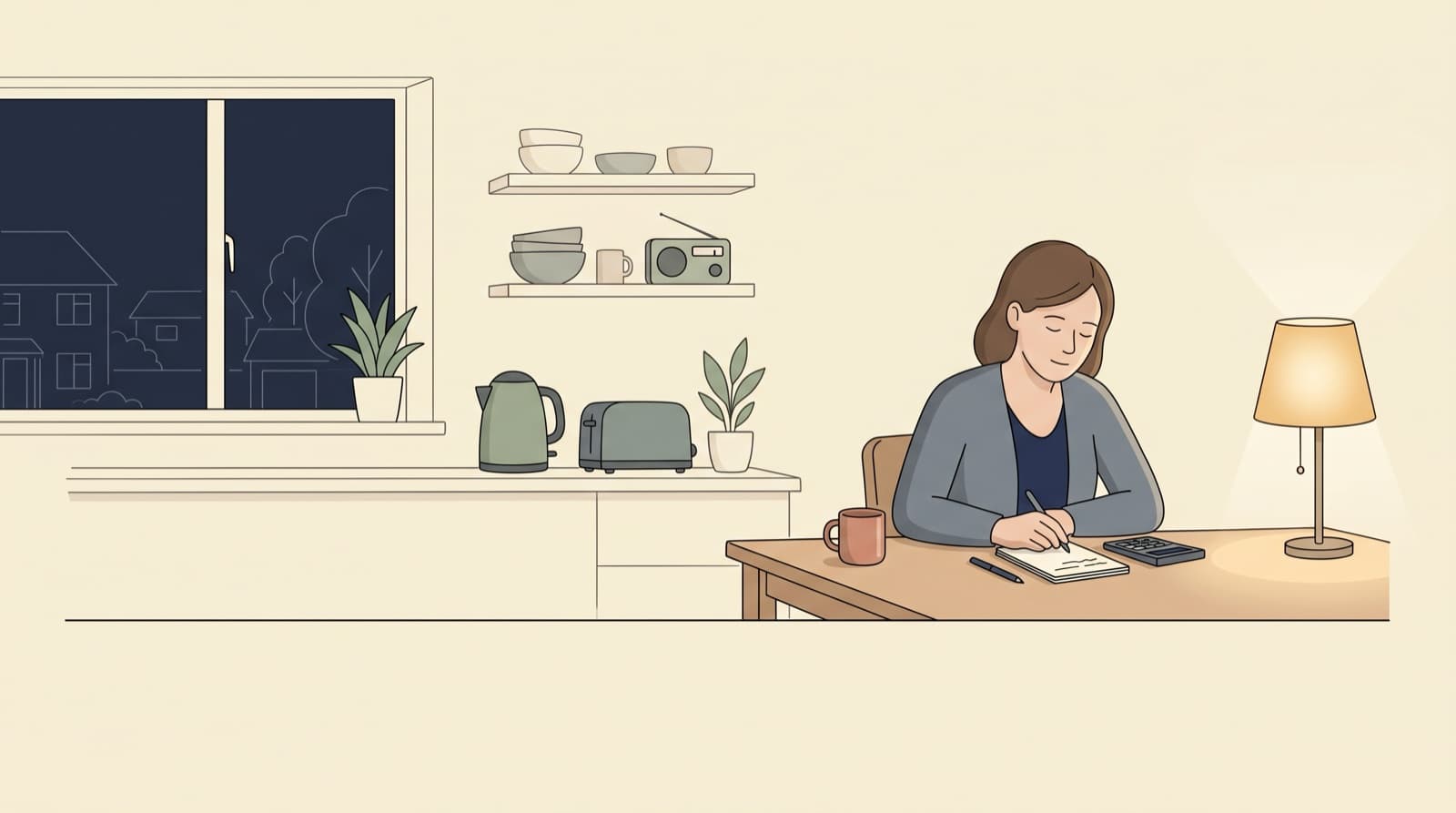
“The £17,000 is not a record of my mistakes. It is a record of every month I made an impossible sum work anyway.”
Somewhere in the country, right now, another single mum is doing the sum I do. One income. Two children. Seventeen thousand pounds of debt. The sum never comes out right, and I do it at the kitchen table after the children are asleep. That part matters. Not during the day, when they might see my face. After the school run, after work, after dinner, after the washing machine has been loaded. Only then do I open the banking app.
The £17,000 is not in one place. It is spread across two credit cards, an overdraft and a catalogue balance. No single number looks catastrophic on its own. Together, they have become the quiet background to my whole life.
My children have no idea. There are still packed lunches. Still birthday presents. Still the right shoes in September. Keeping it that way is deliberate, and it is also exhausting, because protecting children from a number means carrying it entirely alone.
I am not reckless. That is the part I need to say slowly. There is no luxury in this story. No holidays on credit. No designer anything. So how does a working mother end up seventeen thousand pounds down without a single reckless purchase?
It started when the buffer ran out
The debt did not start when the relationship ended. It started about six months later, when the buffer ran out. The costs of my life did not halve when the household did. The rent stayed the same. The children stayed the same. The school shoes, the energy bill, the food shop, all of it built for two incomes and now arriving on one.
Then there is childcare, the cost that decides whether working more is even worth it. In England, after the government expanded the free hours, a part-time nursery place for a child under two still averages around £70 a week. In Scotland it is closer to £122, in Wales £155. For a single parent there is no second adult to cover a shift instead. Every working hour has a price attached to it.
And then there is the money that exists only on paper. Child maintenance. In the last quarter of 2025, around 240,000 parents were due to pay through the government's Collect and Pay service. One in four of them paid nothing at all, roughly 59,000 parents. So tens of thousands of us are budgeting around money that may or may not arrive, and a budget cannot be built on a maybe.
So the first credit card was not a treat. It was a school trip and a car repair landing in the same month. Then Christmas. Then the washing machine. Each time, borrowing felt like a bridge to next month. But next month never had any slack in it either.
A bridge you cannot get off slowly becomes a place you live.
I am not unusual
For a long time I read the debt as evidence that I was failing my children. Then I looked up, away from my own kitchen table, and saw how common this is.
There are 3.2 million lone parent families in the UK, two million of them raising dependent children, and 83% of them are headed by mothers. This is not a niche situation. It is one of the most common family structures in the country.
Look at what the income side actually holds. For a single parent over 25 on Universal Credit, the standard allowance is about £425 a month. Each child adds a child element of around £304, or £352 for an older first child. Child Benefit adds £27 a week for the first child and just under £18 for each one after. Stack that against rent, energy, food and school costs and you get the same sum I do at the table, only at national scale. One 2023 survey put the median income for single parent families, after housing costs, at around £15,000 a year. Fifteen thousand pounds to run an entire household and raise children.
The pressure shows up everywhere. 36% of single parent families have no savings at all, against 17% of couples. 29% are in fuel poverty, against 14%. 13% used a food bank last year, against 3%. And 43% of children in single parent families are growing up in poverty.
Then there is the number that explains the whole thing. Single parents are about one in fourteen of the population. At StepChange, one of the UK's largest debt charities, we are one in four of everyone who walks through the door. My £17,000 is not even extreme. The average person who finally asks StepChange for help arrives with just over £15,500 of unsecured debt. I am roughly the average.
What the number actually is
Numbers this consistent, across millions of households, are not describing individual choices. They are describing a pattern. That same 2023 survey found 76% of single parent families were carrying debt. Three in every four. When three quarters of the people in the same situation have the same problem, the problem is not the people. It is the situation.
Almost everything is priced for two adults. The rent assumes two incomes. The bills assume someone is home to compare tariffs and chase refunds. The job market assumes someone else can do the pick-up. I am asked to be both of those adults, on one salary, and then quietly absorb the gap on a credit card.
So I have started reading the balance differently. Seventeen thousand pounds in the dark behaves differently from seventeen thousand pounds with a plan. The number is information. It is not a verdict on me as a mother.
There is one more cost that never appears on a statement: I am the only adult who knows the number. There is no one to halve the worry with at midnight. That is why the one move I made was not a budgeting system or a side hustle. It was one conversation. StepChange offers free, confidential debt advice, and a quarter of the people they help are single parents. I was not explaining myself to someone who had never heard it before. I was describing the most common story they know.
The sum still does not come out right. Not yet. But there is a difference between doing impossible maths alone at a kitchen table, and doing it with someone whose job is to find the way through.
Free, confidential debt help
You don’t need a plan, or your paperwork in order, before you contact any of these. Most people don’t have either.
Citizens Advice
Local and online guidance on debt, benefits and consumer rights.
citizensadvice.org.ukCashflow Confessions is an editorial and educational platform. We do not provide financial advice or debt solutions.
The story behind the story
One considered email when a new story lands, with the context and sources that didn't fit inside the documentary. No marketing, and you can leave whenever you like.